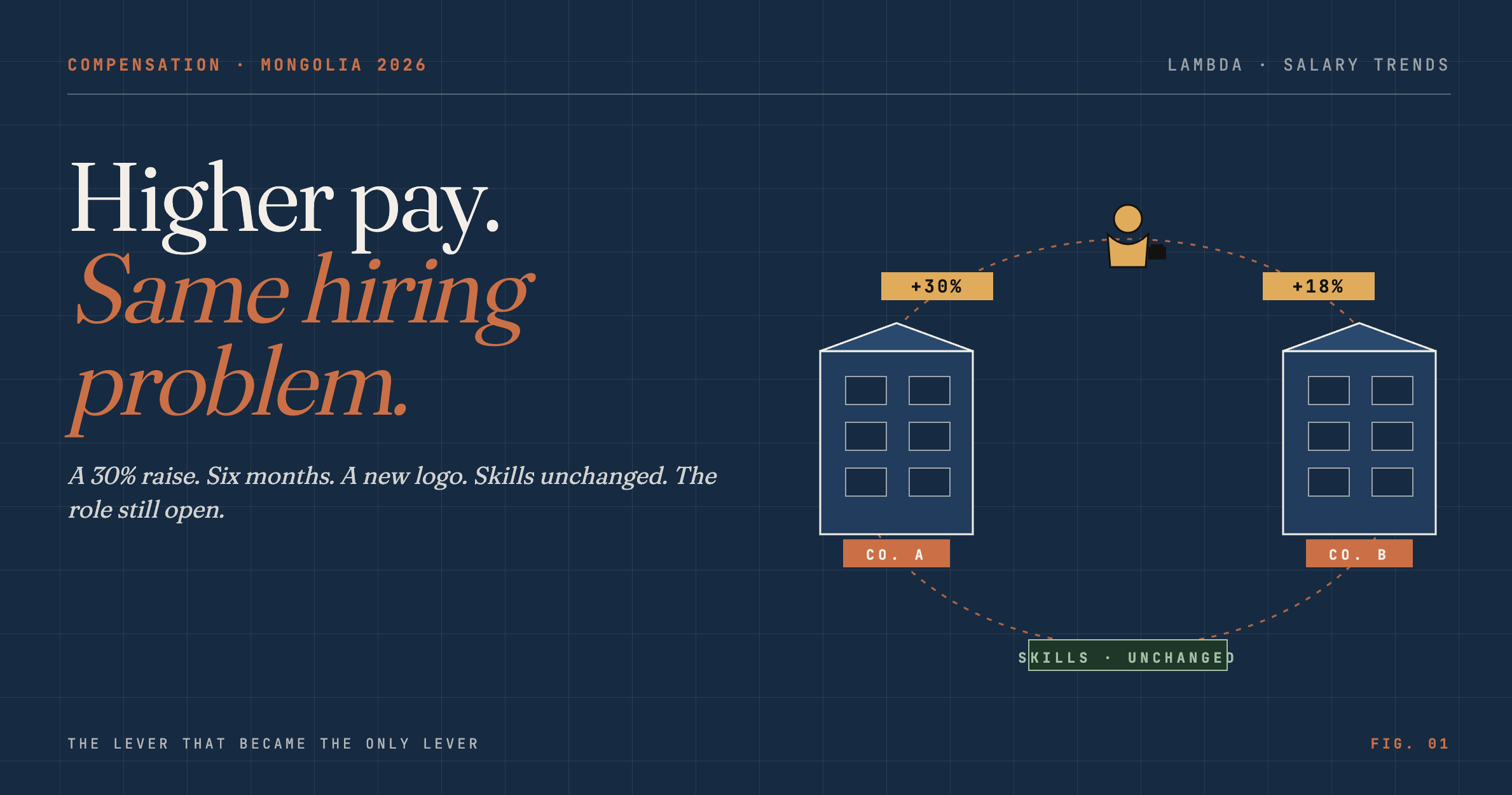
I would like to prefix this article by telling a story about a mid-level employee in Ulaanbaatar city who switches jobs for a 30 percent salary increase. Six months later, he moves again for slightly more. His income rises, but his role barely changes, his skills stagnate, and the company he left is still trying to fill the same position. This cycle is becoming increasingly common in Mongolia’s job market, where rising salaries are not solving hiring problems but quietly making them worse. At first glance, this makes little sense. Higher salaries should attract better talent and fill any open roles in a matter of few days. But the current reality of our situation tells a different story.
Sure, compensation is increasing which is a good thing. But it is not solving the deeper issues in the labor market. Looking into a data from the National Statistics Office of Mongolia, it clearly demonstrates an upward trend in wages. The median monthly salary has been steadily rising in recent years, intensifying from around 1.30 million MNT before 2022 to 1.75 million MNT in 2023. In 2024, it shot up to 2.41 million MNT. By 2025, the median wage reached approximately 2.88 million MNT, with a sharp jump beginning in early 2024. The realistic salary reports are recently published by a private and independent source; Lambda.Global – a rising talent platform with realtime database collected from actual professionals deployed to the private companies and corporate in Mongolia in last couple of years. The median salary here is at least 20-30% more on Lambda’s Annual Salary Report than the one published in NSO Mongolia. It is understandable that state report include government workers including teachers, nurses, and city service workers and so on..
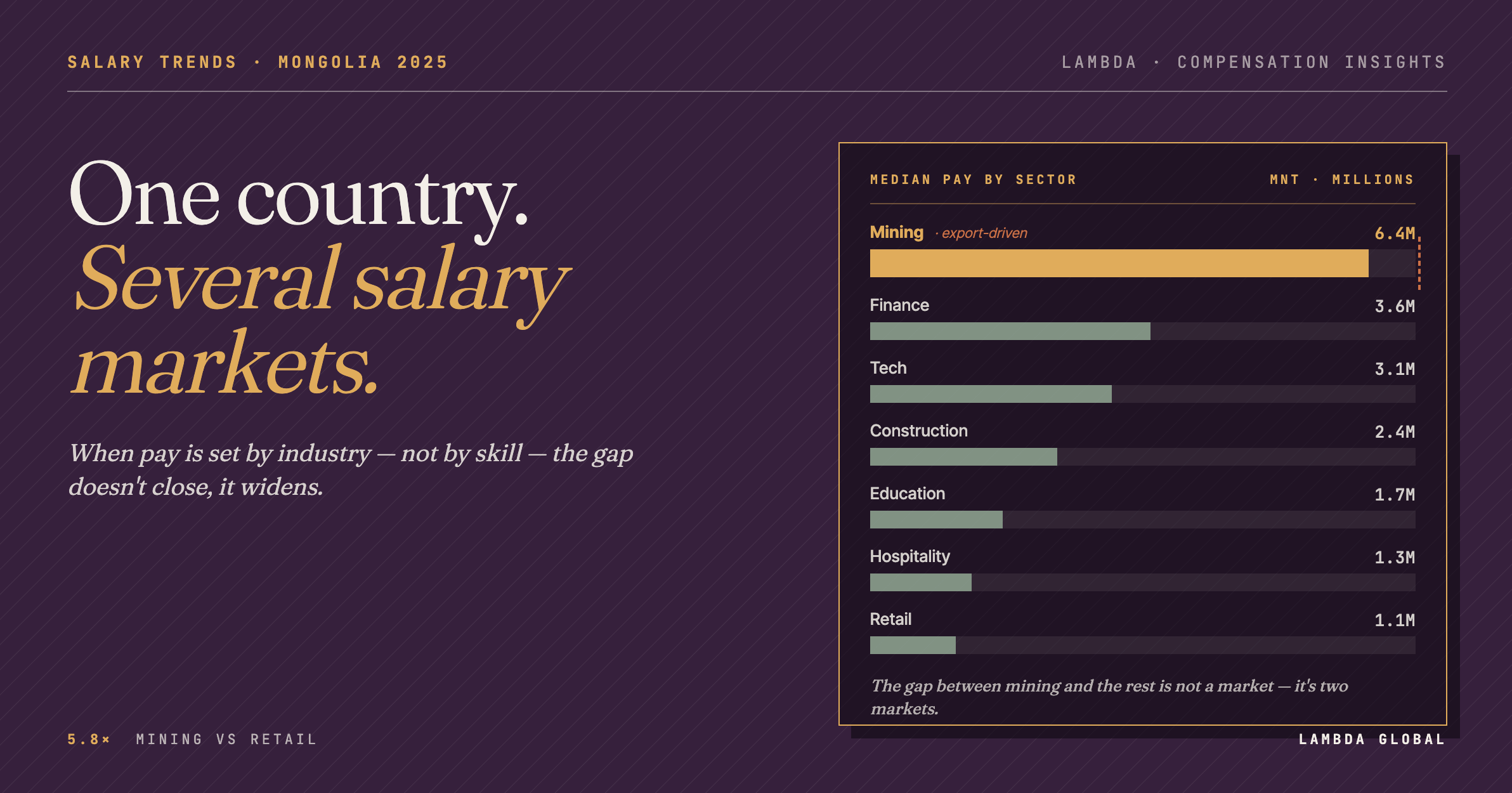
However, the same data also reveals a persistent gap between average and median wages. This gap isn’t only a statistical detail. It can be seen as a sign of income inequality. A higher average wage in comparison to the median means a smaller group of high salary earners is pulling the average up, while most employees earn significantly less to make up for the median. In other words, salary growth is real, but it is uneven. This unevenness becomes even more obvious when looking across industries. Mongolia does not have one salary market. It has several, and they are disconnected from each other. Due to exports and foreign investment, the mining industry offers significantly higher salaries than most other sectors in Mongolia. Whereas, hospitality, retail, and many service jobs remain far behind. Understandably, the latter sectors realistically will not keep up with heavily invested industries like mining. But the result of it all is a fragmented economy where compensation depends mostly on industry rather than skill alone.
This trend is closely tied to the broader picture. According to the World Bank, Mongolia’s recent economic recovery has been largely driven by coal exports and mining revenues. Thanks to the mining sector and other huge players in the economy growth of Mongolia, household income and government spending advanced in 2023. However, rising wages and expenditure are also likely to increase inflation. This ends up creating a cycle where higher pay comes from growth but also leads to higher prices for everything.
But the core issue is not that salaries are increasing. The issue is how and why they are increasing. Many companies in Mongolia are competing for talent by raising salaries rather than building long term talent pipelines. Employees who join for higher pay often do not stay long term. They move again when another company offers slightly more. From the employee’s perspective, this is obviously a rational decision. If companies are not offering growth, training, or clear career paths, salary becomes the only lever that matters. From the company’s perspective, this leads to constant rotation and rising salaries.
This pattern can already be observable in today’s market. On hiring platforms like Zangia.mn, many mid-level roles are bundled with similar salary ranges between 3.0 and 3.5 million MNT. However, on the newest platform – Lambda.Global, the average compensation tend to be much higher between 4.0 to 5 million MNT as these offers are more focused on top talents or highly skilled specialists. Simultaneously, many job postings do not clearly communicate total compensation or benefits for being hired to their companies.
Salary is emphasized at the top of all other things, while training, development, or long-term incentives are either unclear or absent within their offers. As a result, companies have a narrow competition based almost entirely on who can pay the most amount of money. The consequence of this approach is that these companies end up overpaying for positions without improving productivity. Employees gain higher salaries in the short term, but without structured development, their long-term career growth becomes questionable.
This imbalance is also geographic. Jobs with higher salaries are largely concentrated in Ulaanbaatar city, the capital of every Mongolian’s heart. Opportunities in other regions and provinces are still limited, leading more people to move to the city. The challenges in the capital go beyond employment. As highlighted by the World Bank, living conditions in ger districts negatively affect productivity, health, and long-term earning potential. Employees facing poor housing and environmental conditions are more likely to be late to work, earn less, and exit the workforce earlier. This turns urban inequality into a labor market issue.
All of these factors point to the same conclusion. Mongolia’s salary growth is not being driven by a coordinated improvement in the labor market. It is being pushed by specific sectors, especially mining, and amplified by short term hiring strategies. The problem is not that companies are paying too much. It is that they are solely relying on salary as the primary solution to strategic and structural challenges. A more sustainable approach will require a shift in how companies think about talent. Compensation still matters, but it cannot be the only focus. Essential long-term investments are in training, internal mobility, and leadership development. Employees need to see their future within an organization, not just a paycheck for the upcoming few years.
The current method of increasing wages is already reaching its limit. Rising salaries have not eliminated hiring difficulties. Retention of employees remains a challenge to many companies. And the gap between high paying sectors and the rest of the economy continues to widen as we move on with our lives. The next phase of Mongolia’s labor market will depend on whether companies can move beyond reactive salary increases. Those that continue to compete only on pay will face increasing costs without solving their talent problems. Those that invest in developing people, building skills, and creating clear career paths will have a more stable and competitive workforce.
Mongolia’s economy remains positive, supported by its resources sector and growing economy. The opportunity is clear. The challenge is execution. To turn higher salaries into lasting growth, companies should think long-term instead of just focusing on quick wins for the day. Those that continue to rely on salary alone will face rising costs without solving their hiring challenges. Those that invest in people will define the next phase of Mongolia’s workforce. Mongolia is not facing a wage problem. It is facing a talent development problem.
Sources: