More than half of the employees in Mongolia do not hold jobs in their field of expertise. Moreover, it’s totally unassociated with what they have been training themselves in. In other words, the issue with an individual who holds a bachelor’s degree in accounting but is selling mobile phones on a kiosk is not a lack of willpower. The issue here is the market moving too fast for the labor force.
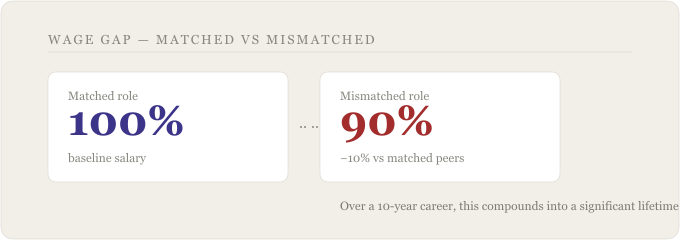
As such, the statistics on this topic are striking. According to a survey done in 2024, about 53% of workers in Mongolia find themselves in occupations unrelated to their major. Moreover, workers in unrelated jobs earn approximately 10% less compared to those with relevant qualifications in their fields of work. This statistic looks especially alarming taking into account the fact that the private sector in Mongolia is not reducing its number but expanding in terms of diversity and competition. In fact, fintech, logistics, professional services and mining supply chains require a skilled workforce.
“10% difference is quite negligible” some people may say. Yes, that would seem true at first sight. Imagine this disparity growing over ten years and you will see the result. Imagine your property growing over the span of time in a whole economy and you will understand why its productivity rate always stays lower than the real one.
The year the government decided to act
The Ministry of Family, Labor and Social Protection named 2026 as “The Year of Employment Promotion.” It is not a motto for an advertisement. Rather, it reflects the understanding that AI, automation, and changes in the economy influence the labor market and the skills necessary for it. The government promised to train over 60,000 people employed in the public sector in AI, data management, and digital security through a contract with Oracle for three years. Furthermore, the National AI Program backed by UNICEF Mongolia has launched its own educational initiatives. Those are significant investments.
However, merely training will not mean anything. The employee who finishes a course on databases management is unaware of the dynamics in which his/her skills are needed in the job market. The young specialist who obtains three diplomas in AI is not aware of industries that offer jobs for people who possess such knowledge today. A person employed in a profession which he or she had not even studied for requires more than a course. The specialist needs a signal.
What makes the signal work
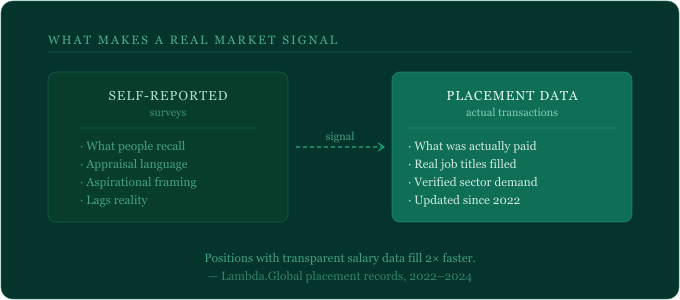
The Lambda.Global platform is not a provider of educational programs or certificates. However, it provides information about the in-demand skills requested by employers, the emerging professions and salary levels. This data is based on the company’s placements, unlike self-reported surveys that were collected since 2022. There is a difference between these two sources of information. A self-reported survey is based on what a person recalls placing on his/her latest appraisal report. On the other hand, placement information reveals what was actually paid for the service provided.
The same placement information can be of great use for professionals who have obtained some education but work in a totally different field. The data will provide information about the developing sectors in the job market, the new professions that are emerging and salaries offered for them. In addition, the data will tell what related skills to obtain and what to expect in terms of income. The Lambda.Global platform is available in English which makes it easier for many Mongolian residents living abroad to navigate the domestic labor market.
Data from Lambda shows what common sense says to be true. Positions advertised with salary information and open searches will fill up twice as quickly as those advertised through conventional recruitment. Transparency in the marketplace will improve the matching process. This is not only beneficial to companies; it also helps the 53% of people who are in the wrong job position and are waiting to be seen for what they can do.
The simplest fix is the one people keep overlooking
The digital ecosystem of Mongolia is solid. 84% of people have internet access. The labor force is made up of young digital natives who are also gradually becoming platform-friendly. Money is being invested into training by the government. The factor that’s been neglected is yet another application or yet another government report. What is required is a layer of data analysis of the labor market that would make all of those initiatives relevant to the employment picture.
Lambda.Global is here to provide such a layer. No inspirational mottos. No list of promising professions. Real-time information that tracks any changes within the market and shows the areas of opportunity to everyone who is prepared to do so. 53% is not going to change by itself. It can change, however. Professionals equipped with proper knowledge will be able to finally find their true calling within the job market.
References
- MONTSAME, AI, Data, Drones, and Cybersecurity Professions in High Demand in Mongolia
- Ministry of Family, Labour, and Social Protection, Year of Employment Promotion
- Oracle Academy Blog, Ministry of Digital Development launches three-year AI and big data skills program with Oracle
- UNDP Mongolia, Navigating the Next Great Divergence
- Lambda.Global, Sector Salary and Skills Reports