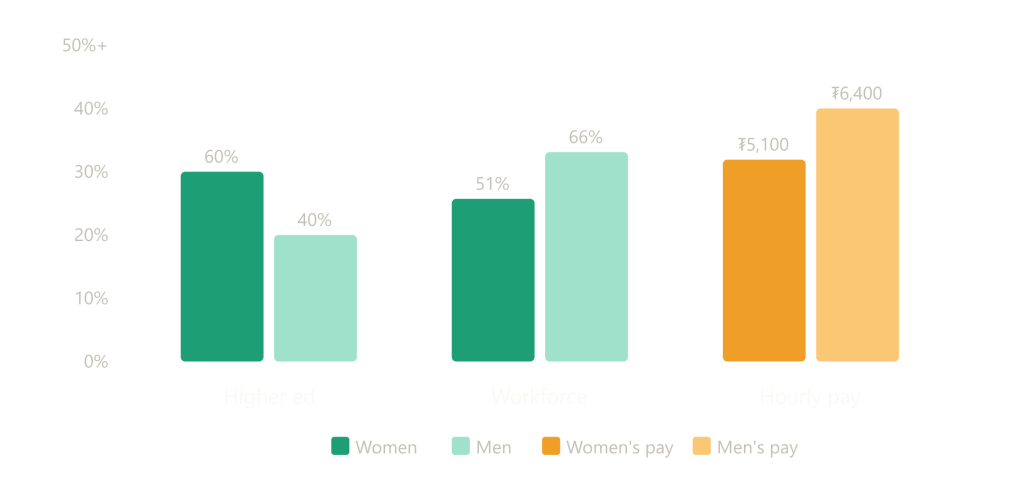
Walk into any classroom at a university in Ulaanbaatar and women outnumber men in droves. They comprise 60% plus of all higher education students in Mongolia and walk the halls in overwhelming numbers. These are intelligent, motivated women. It’s once they enter the job market, however, that the scales begin to tip against them.
A report from 2022, funded by the National Statistics Office and UNFPA, outlines the problem. Labor force participation rates differ substantially where 51.5% are women versus 66.4% are men. Among management positions, women occupy almost 40% of roughly 60,000 vacancies but earn significantly less. Men earn 6,400 tugriks an hour, women earn 5,100. Regardless of profession, level or discussion, men always win the race.
According to the World Economic Forum’s 2024 Global Gender Gap Report, Mongolia stands at 90th out of 146 countries and there was no change in ten years. While Mongolia excels at educational parity within the region, the economy holds it back, offering much less to women as opportunities are not allocated evenly.
The unexplained information
A woman who has graduated with a finance degree and started an entry-level job at a bank in UB accepts her starting salary without negotiation because no one tells her what it should be. With the exact same qualifications, her male classmate asks for more and receives it. Years later at their reunion they discover they were paid differently from the start and all those disparities compound, leading her to earn significantly less over time (in savings, in bonuses, in base salary increases).
The issue here isn’t one of confidence or the willingness to negotiate, but of lack of information. In the absence of publicly available salary ranges, negotiation ends up favoring those who already know more. Traditionally, women, first-generation professionals, or individuals who were not privy to insider knowledge, lose out.
A UNFPA-supported study demonstrates this. Women with children suffer greater setbacks. The few remote or part-time jobs that exist are overshadowed by persistent expectations for women to work 9 to 5. This forces many women out of regular employment altogether, explaining why most small businesses, 68%, are run by women. These women have no employees since 75% operate from their homes, manage family while trying to work, and sell handcrafted goods in order to survive, without recognition from the formal job market.
What the data shows on the way forward
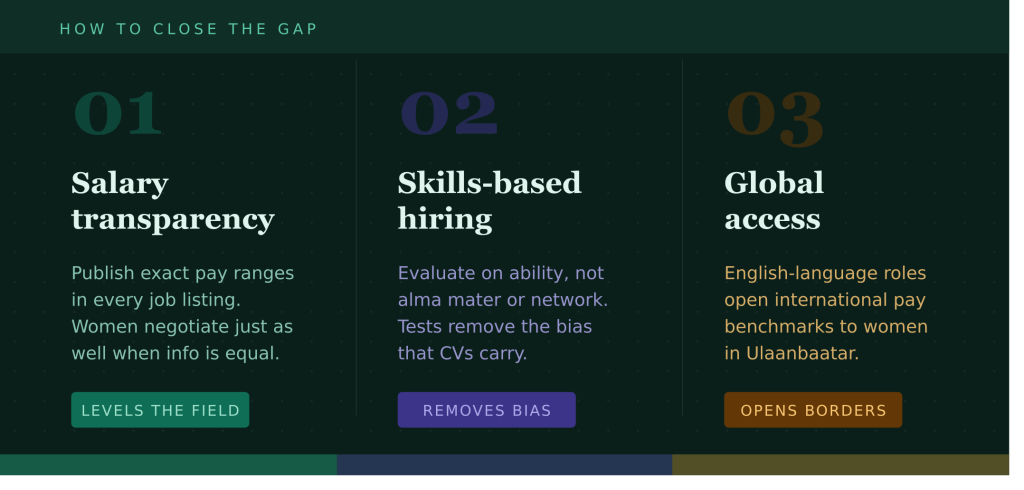
Transparency makes a difference. The introduction of salary ranges in job descriptions can significantly narrow the gender gap in negotiations. A global meta-analysis published in the Journal of Applied Psychology proved that when information is clearly provided and expectations are understood, women negotiate just as effectively as men do. This means the issue is not capability but absence of knowledge.
Skill-based hiring eliminates subjective evaluations and biases. Hiring solely on skills rather than based on alma mater or network connections removes factors that hinder women’s progress and helps provide unbiased criteria. A coding test assesses aptitude and programming skills, a financial modeling exercise gauges someone’s technical abilities, no matter their gender. The more relevant an assessment is to the actual work performed, the less likely biases are to infiltrate a hiring process.
Lambda.Global takes this a step further
Lambda.Global combats the information asymmetry that underlies the gender pay gap. Each posting on the platform specifies an exact, real-world salary for the position, not figures derived from past outdated survey data. Women who apply can be certain of the earning potential from the outset, removing the anxiety and guessing game that is so common.
Lambda also focuses on skill-based evaluations rather than traditional resumes and CVs. This puts all candidates, regardless of prior connections, on a more even playing field, providing equal opportunities for women who may possess the same level of skill but lack access to influential networks.
Moreover, since Lambda conducts all job descriptions and communication in English, the platform unlocks a wealth of international opportunities for Mongolian women professionals. Imagine if a controller in Ulaanbaatar can see a fair salary for the exact same role at a firm elsewhere, or how much he or she can earn working part-time as a CFO. Through Lambda, opportunities are clear but without giving anything away, it is up to each candidate to see where they might fit.
The final word
Most businesses in Mongolia claim they support gender diversity, but very few act upon it in ways that matter: publishing salary ranges, auditing pay gaps or holding managers accountable for their discriminatory practices.
The only real way to get women into higher-level roles and see progress on equality, is to first publish ranges, evaluate using skill tests and remove the uncertainty factor. Women are skilled enough; they just need an environment where that can be recognized.
Lambda.Global is helping make this a reality. Forget hollow slogans about diversity; this platform offers something tangible. Its framework offers payment transparency, with salaries based on actual qualifications and not speculation.
The gender gap didn’t arise overnight and it won’t be solved overnight either. But the tools are available to narrow that gap right now. The question is, will companies make use of them?
References
- National Statistics Office of Mongolia and UNFPA, Gender and Employment Study (2022)
- World Economic Forum, Global Gender Gap Report (2024)
- Journal of Applied Psychology, Gender Differences in Negotiation: A Meta-Analysis
- Lambda.Global, Sector Salary and Skills Reports (2025–2026)